Insight
Break through your growth ceiling
A connected system that unlocks value today, tomorrow and beyond
You’re not missing data. You're missing connection.

When something breaks, many leaders rush to fix it with a shiny new tool that promises quick and easy answers. Slow dashboard? Add another intelligence layer. Teams can’t agree on the numbers? Buy another reporting platform. The fixes are visible, fast, and can be worked into a budget.
Acquiring a new tool often seems like the easy fix. But it can also create the very problem it’s meant to solve. It adds another dependency in your stack, another source of data, and another system for teams to navigate.
The more difficult, and more important, question is whether the tools you already have can work together. That requires time and diagnosis, not acquisition.
So instead of asking what new tool to acquire, businesses should first ask whether their existing systems are built to agree with each other. Is there a common layer that every system and team can trust, learn from, and act on?
Same company, different numbers
When definitions, timelines, and sources of truth live in separate places across functions, reconciliation is usually done manually and is prone to error.
This is the cost of fragmentation, which is expensive in ways that don't show up on a dashboard: slower decisions, additional headcount, and engineering time spent building one-off integrations that solve last quarter’s version of the problem.
For example: two teams can look at the same customer and see two different businesses. One sees an active account while another sees a churn risk. One works from this quarter’s numbers, and the other is still operating from last month’s forecast. The information may already exist, but the organization doesn’t have a shared understanding of what it means.
Fragmentation rarely looks like a failure. It looks like four healthy systems, four accurate records, and no way to join them. That was survivable when a person did the reconciling because a person notices when the story doesn’t hold together. An agent doesn’t. It takes the record it was given and proceeds, at speed, across every system downstream.
50% of CEOs surveyed in IBM’s 2026 CEO Study said that the pace of their own technology investment had left them with disconnected systems, even as more than two-thirds pointed to integrated data architecture as critical to cross-functional collaboration.
Living memory, your key to connection
Here’s the thing: Your systems already have most of the data they need.
Your CRM is tracking the deal, your support platform already has the churn signal, and your finance system has the margin. None of that was ever the problem.
The problem is that none of them have a shared way of working with the same data.
There’s no common definition of the customer, or one timeline of what happened and when. And as a result, there isn’t a single source of truth shared by every team.
Shared intelligence is what gives those systems a common context for using the data they already have. It creates a baseline understanding that each team can reference instead of reconstructing the story. And it’s not to be confused with a data warehouse, which simply stores information without updating it for each new decision over time.
But this only works if the intelligence stays current. Living Memory is how we make that possible.
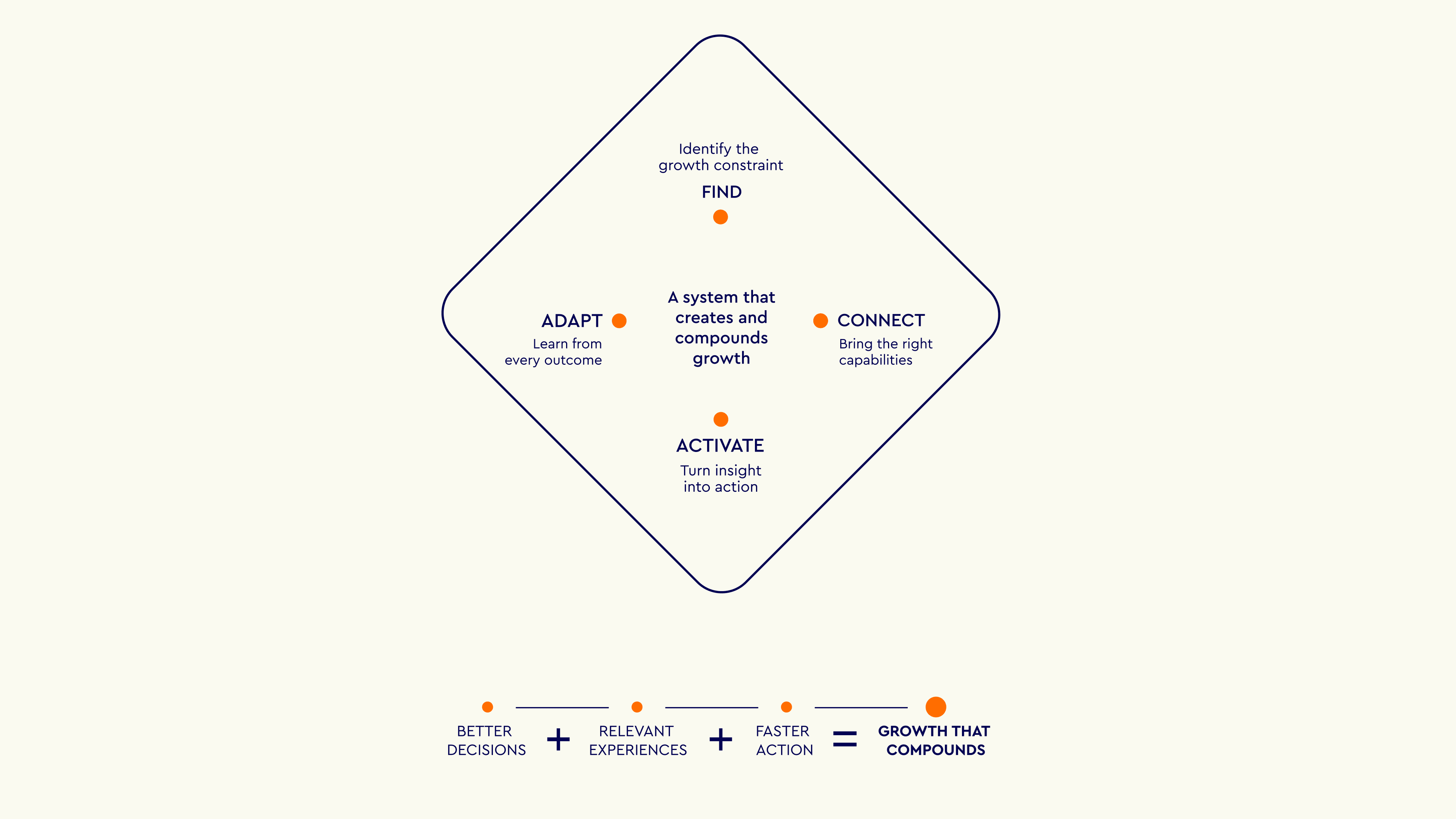
As we've said in the past, shared intelligence in practice is what we call Living Memory. It doesn’t sit on top of the stack; it’s embedded throughout it, holding an organization’s shared truth, keeping it current, and enabling every system and team to draw from the same understanding of the business as it exists today.
Cross-functional transformation only works when every team is on the same page. Living Memory gives each function a shared context, letting them build on what came before.
Without it, teams act on fragmented data, resetting growth instead of letting it compound.
Stop and think before you scale
On a small scale, fragmentation can be an annoyance. Someone catches the discrepancy, fixes the spreadsheet, sends an email, or explains the missing context to a colleague. At enterprise scale, those manual corrections can’t keep up.
Once inconsistent information enters an automated workflow, it can travel through the systems that depend on it, shaping decisions before anyone has a chance to correct it.
That's why orchestration starts with a shared foundation. Every system and team needs access to the same context, so information can move through the organization with consistency and confidence.
The tools your business already has are probably capable of more than you’re asking of them. What they’re missing isn’t a new capability, but a shared understanding of the business they’re meant to serve. Without that foundation, adding more technology will only amplify existing gaps.
When you build that foundation, the technology you already have can start working together rather than as a collection of parts. As you add new capabilities, each one can strengthen the architecture and add value to the system as a whole.
Get our latest insights on experience, commerce, data and AI from the people building the systems behind it.